
URAI Symposium

Le rendez-vous annuel
autour de l'Intelligence Artificielle !

Symposium URAI – Intelligence Artificielle dans le Rhin supérieur

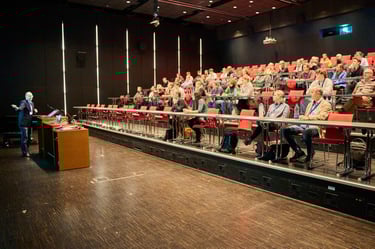
Chaque année, TriRhenaTech organise le Symposium URAI (Upper-Rhine Artificial Intelligence Symposium), un événement scientifique trinationale dédié à l’intelligence artificielle. Il se tient successivement dans un pays différent, renforçant ainsi le caractère transfrontalier de l’alliance.

Éditions récentes :
- 2019, à Offenburg (Allemagne) : from Research to Application
- 2020, à Karlsruhe (Allemagne) : Artificial Intelligence: Research Impact on Key Industries
- 2021, à Kaiserslautern (Allemagne) : autour de l’application de l’IA aux sciences de la vie, à l’industrie 4.0 et à la mobilité
- 2022, à Furtwangen (Allemagne) : AI in Medicine, Manufacturing and beyond
- 2023, à Mulhouse (France) à l’ENSISA : IA pour les séries temporelles, la robotique et au-delà
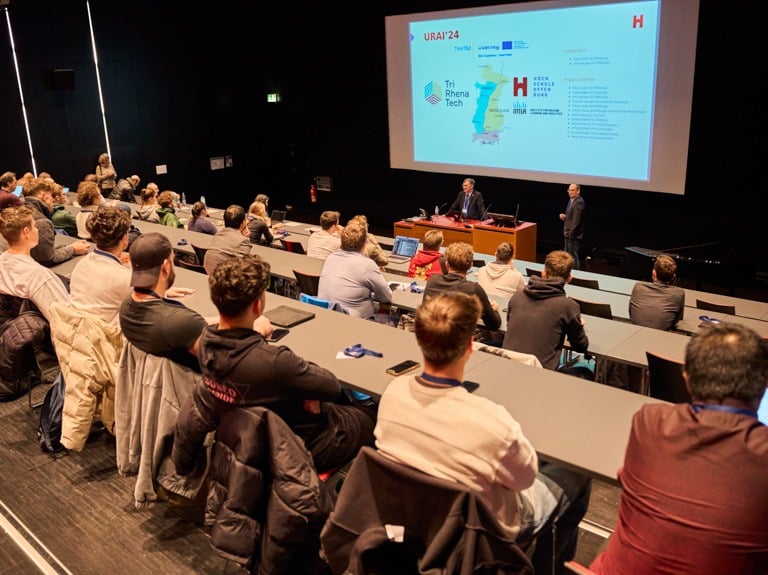
- 2024, à Offenburg (Allemagne) : Applied AI in the age of Generative AI
- 2025, à Strasbourg (France) : AI in Medicine & Healthcare : from algorithm to clinical application

Ce modèle itinérant permet à TriRhenaTech de promouvoir chaque année une thématique innovante de l’intelligence artificielle, tout en renforçant les synergies entre les institutions, les chercheurs et les experts des trois pays.
Prochaine date

Mercredi 4 Novembre à Windisch

2026

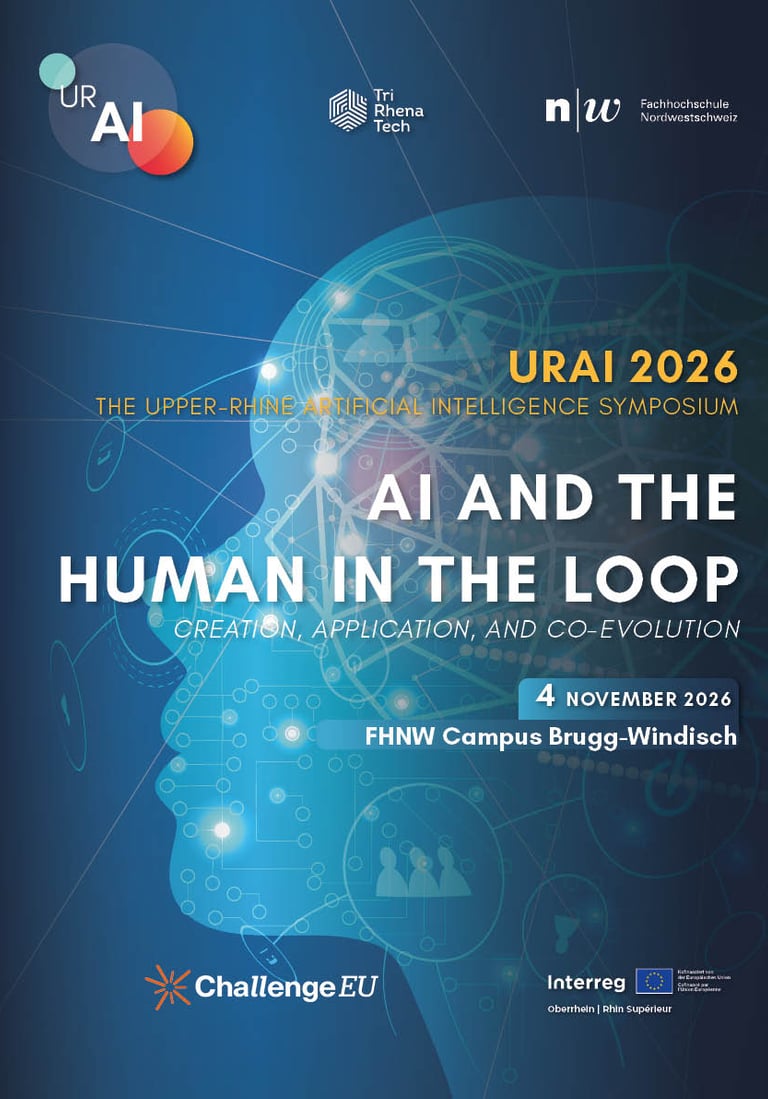
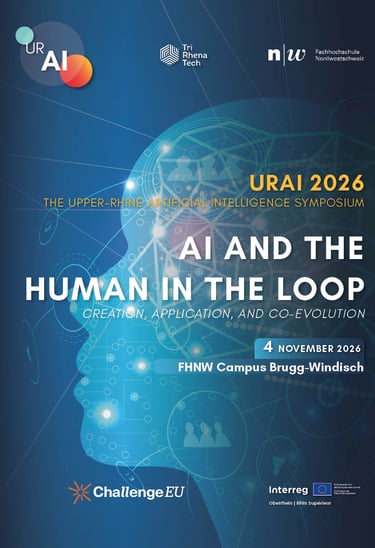
URAI 2026

Upper Rhine AI Symposium 2026 – à Windisch

AI and the Human in the Loop:
Creation, Application, and Co-Evolution


CALENDRIER :
Extended Abstract Submission: 12 June 2026
Notification of Acceptance: 03 July 2026
Full Paper Submission: 30 September 2026
URAI Symposium: 04 November 2026

LIEU : University of Applied Sciences and Arts Northwestern Switzerland FHNW
FHNW Campus Brugg-Windisch
Switzerland

URAI 2026 : appel à contribution
AI and the Human in the Loop:
Creation, Application, and Co-Evolution

Deadline : 12.06.2026

Vous souhaitez entrer en contact avec l'équipe organisatrice ? Contactez : hello@trirhenatech.org

PRÉSENTATION

Artificial intelligence is rapidly moving from research laboratories into real-world environments. The successful deployment of AI systems requires close interaction between algorithmic development, domain expertise, and human decision-making. URAI 2026 explores how AI technologies are created, applied, and co-evolved through human-AI collaboration — across disciplines and application domains.

The TriRhenaTech network of universities plays a crucial role in shaping AI’s responsible future. We particularly welcome submissions that align with the key research strengths of the Universities of Applied Sciences and Arts in the Upper Rhine region, members of TriRhenaTech.

Topics of Interest

We invite theoretical, technical, and applied research contributions addressing (but not limited to) the following areas:

1. AI System Development
· Machine learning models, deep learning, and neural network architectures
· Software engineering for AI: frameworks, tools, and best practices
· MLOps and AI lifecycle management
· AI-assisted software development: automated code generation, debugging, and testing
· AI-driven software engineering processes: requirements engineering, system design, and continuous integration

2. Human-AI Interaction
· Human-in-the-loop systems and decision support
· Hybrid intelligence: integrating human intuition with machine learning
· AI as a creative and collaborative assistant in design, engineering, and the arts
· AI and the Future of Work: human-AI collaboration, new organizational models, skill transformation, and AI-supported work environments

3. AI in Application Domains
· Healthcare & Life Sciences: AI in biotechnology, diagnostics, and patient care, digital health, and preventive healthcare systems
· Industry & Smart Manufacturing: AI in Industry 4.0, automation, and additive manufacturing
· Sustainability & Energy: AI for climate-neutral solutions, decarbonization, smart grids, energy-efficient systems and sustainable infrastructure

4. Responsible and Trustworthy AI
· Transparent, explainable, and trustworthy AI
· AI ethics, bias mitigation, and regulatory compliance
· Cybersecurity and safety in AI-driven environments

Contributions linking AI research with societal transformation in the areas of work, sustainability, and health are particularly encouraged.

Call for Papers

Extended Abstract Submission: 12 June 2026
Notification of Acceptance: 03 July 2026
Full Paper Submission: 30 September 2026
URAI Symposium: 04 November 2026

Submission Tracks

URAI 2026 offers two submission tracks under the same thematic scope. The primary scientific focus of the symposium lies on original research contributions.

Track 1: Original Research Contributions

This track welcomes original, unpublished research addressing the topics outlined above, e.g. applied research describing implemented AI systems, case studies of AI deployment, human-AI collaboration systems, interdisciplinary research combining AI with domain sciences, or engineering approaches to AI integration.

Submission Process
· Authors submit an extended abstract of 1–2 pages describing their research.
· Based on the evaluation of the extended abstracts, submissions will be accepted or rejected and assigned to either oral presentation or poster presentation.
· Authors of accepted contributions are invited to submit a full paper (maximum 8 pages) for inclusion in the symposium proceedings.
· Full papers undergo a formal and editorial review prior to publication.

Track 2: Journal/Conference-First Contributions

This track invites contributions that have been published within the last 18 months in peer-reviewed journals or international conferences across relevant disciplines. The aim is to increase visibility of high-quality research within the Upper Rhine AI community and foster cross-border exchange.

Submission Process
· Authors submit an extended abstract of 1–2 pages together with a reference to the original publication.
· All extended abstracts undergo a review to ensure relevance and alignment with the symposium theme.
· Based on the evaluation of the extended abstracts, submissions will be accepted or rejected and assigned to either oral presentation or poster presentation.
· No additional full paper is required. Accepted extended abstracts may be included in the symposium proceedings.

Submissions will be reviewed by the Programme Committee. Further information on evaluation criteria, proceedings, and publication details will be announced shortly.

Crédits Photo : Hoschschule Offenburg